How to Budget on a Low Income — $2,000 a Month Plan
In this article
- The $2,000 Plan at a Glance
- 1. Rent First, at 40% or Less
- 2. Food: $300 With a Weekly Shop
- 3. Transport: $200, No Surprises
- 4. Bills: $250, and Call About Every One
- 5. Debt $150, Savings $100 — Both, Every Month
- 6. Personal $100 and Buffer $100 — the Lines That Save the Budget
- How to Make It Work on Your Pay
- FAQ
- Conclusion
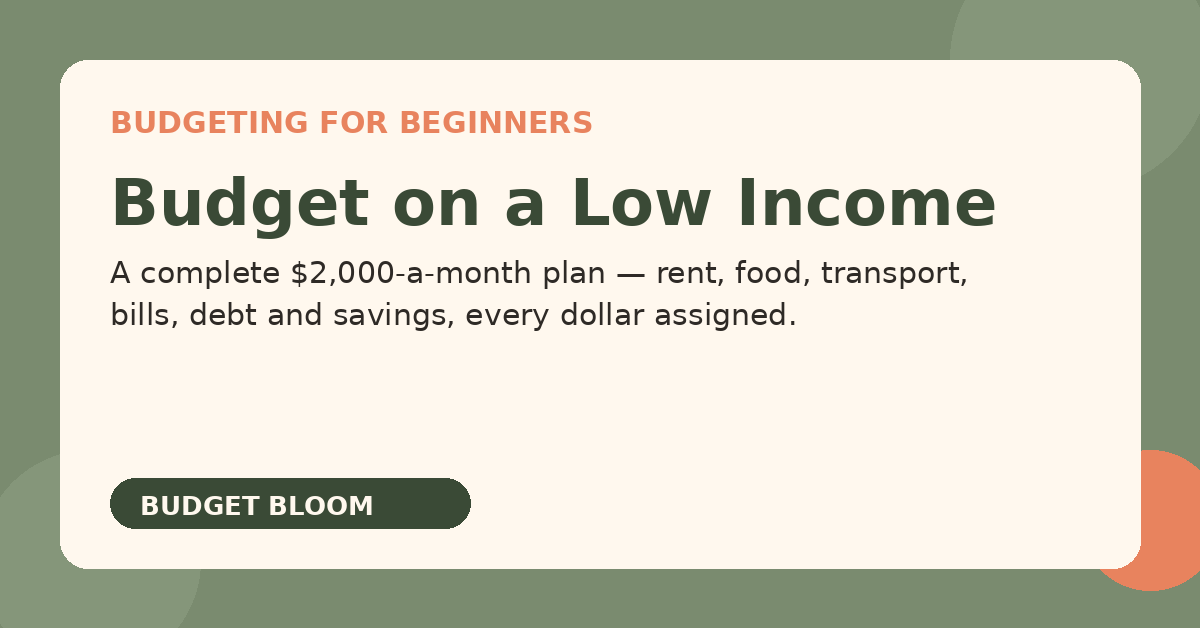
A low income does not mean no budget — it means every dollar needs a job before the month starts. This plan covers a full month on $2,000 take-home pay, with rent, food, transport, bills, debt and savings all included. Adjust the numbers to your pay, but keep the rule: income minus plan must equal zero, so no dollar is left to drift away.
The $2,000 Plan at a Glance
| Category | Amount | Share |
|---|---|---|
| Rent | $800 | 40% |
| Food and groceries | $300 | 15% |
| Transport | $200 | 10% |
| Bills (phone, internet, utilities) | $250 | 12.5% |
| Debt payment | $150 | 7.5% |
| Savings | $100 | 5% |
| Personal and fun | $100 | 5% |
| Buffer for surprises | $100 | 5% |
| Total | $2,000 | 100% |
Check the maths: $800 + $300 + $200 + $250 + $150 + $100 + $100 + $100 = $2,000. If your pay is different, scale each line by the same share — the proportions are the plan.
1. Rent First, at 40% or Less
Rent is the biggest line, so it decides everything else. On $2,000 a month, $800 is the ceiling. If your rent is higher, the rest of the plan squeezes — which is a sign to look for a cheaper room, a roommate, or a move when the lease ends. Never let rent eat the food or savings lines for more than a month or two.
2. Food: $300 With a Weekly Shop
$300 a month is $75 a week. Plan meals before you shop, buy the same staples every week, and cook in batches. Our meal plan on $100 a week shows a full week of dinners for $45, and our 25 grocery savings habits can pull this line down further if you need room elsewhere.
3. Transport: $200, No Surprises
Bus pass, fuel, or a mix — pick the cheapest reliable option and put exactly $200 aside. If you drive, this line also covers one small repair a month, saved in advance, so a flat tyre does not become credit card debt. Walking or cycling one trip a week is free money back into this line.
4. Bills: $250, and Call About Every One
Phone, internet, electricity, water — $250 covers the basics for most beginners. Call each provider once a year and ask for a lower rate; one call commonly saves $20–35 a month. That is step 6 of our Save $500 Fast plan, and on a low income it is the highest-value hour you will spend.
5. Debt $150, Savings $100 — Both, Every Month
Pay $150 to debt and save $100, even while money is tight. The $150 keeps the debt shrinking — see our credit card payoff plan for why the payment size matters so much. The $100 builds your buffer: three months of it finishes our Save $300 in 4 Weeks plan. If you must choose, pay the minimum on debt first, then save what is left — never save $0.
6. Personal $100 and Buffer $100 — the Lines That Save the Budget
$100 for fun and $100 for surprises are not luxuries — they are what keep the budget alive. A budget with no fun fails in week two. A budget with no buffer breaks on the first surprise bill. Protect both lines, and use the 50/30/20 framework as a looser guide once your pay grows.
How to Make It Work on Your Pay
- Pay is $1,500? Use the same shares: rent $600, food $225, transport $150, bills $190, debt $110, savings $75, personal $75, buffer $75.
- Pay is $2,500? Keep the same plan and send the extra $500 to debt first, then savings — do not let lifestyle grow with pay.
- Pay varies month to month? Budget on your lowest recent month, and treat extra pay as a bonus to debt or savings, never as spending money.
FAQ
What if my rent alone is more than 40%? Then the plan still works, but something else must shrink: food, transport, or fun. Write the real numbers down — guessing is what makes low-income budgets fail. If rent is over 50%, a cheaper living situation is the real fix, not a tighter grocery list.
Should I save anything while I still have debt? Yes — a small amount. $100 a month to savings while paying $150 to debt means the next emergency does not go back on the card. That is how the cycle actually breaks.
How do I stick to it? Check in for 10 minutes every week: what is left in each line? That weekly check is step 7 of our paycheck-to-paycheck guide — it is the habit that makes every other step work.
Conclusion
Budgeting on $2,000 a month is not about restriction — it is about assignment. Rent $800, food $300, transport $200, bills $250, debt $150, savings $100, personal $100, buffer $100: every dollar has a job, and the total is exactly $2,000. Write your own version tonight, using your real pay and your real rent, and check in for 10 minutes every week. The plan works at any income — the shares stay, only the numbers change.
New here?
Start with the plan that matches your next money goal, and save the pin so you can find it again.
Follow Budget Bloom on Pinterest