Save $300 in 4 Weeks — Start Your Emergency Fund (Beginner Plan)
In this article
One surprise car repair. One urgent trip to the dentist. One broken phone. For most beginners, a single unexpected expense like this goes straight onto a credit card, and the debt lingers for months. An emergency fund exists to break that cycle — and your first one does not need to be huge. This plan helps you save $300 in 4 weeks, at $75 a week, using small steps that fit a normal life. Four weeks from today, you can have a real safety net started, probably for the first time ever.
Why $300 Is the Right First Goal
A fully loaded emergency fund of three to six months of expenses is a great long-term target, but it is a discouraging first one. $300 is different:
- It is small enough to finish in a single month.
- It is big enough to cover many real mini-emergencies: a car battery, a minor repair, a copay, a replacement tire.
- Finishing it proves you can save on purpose — and that confidence makes the next goal easier.
Think of $300 as your starter cushion, not your final destination. Once it is built, you keep going. But every big fund starts with a first $300.
The $75-a-Week Plan
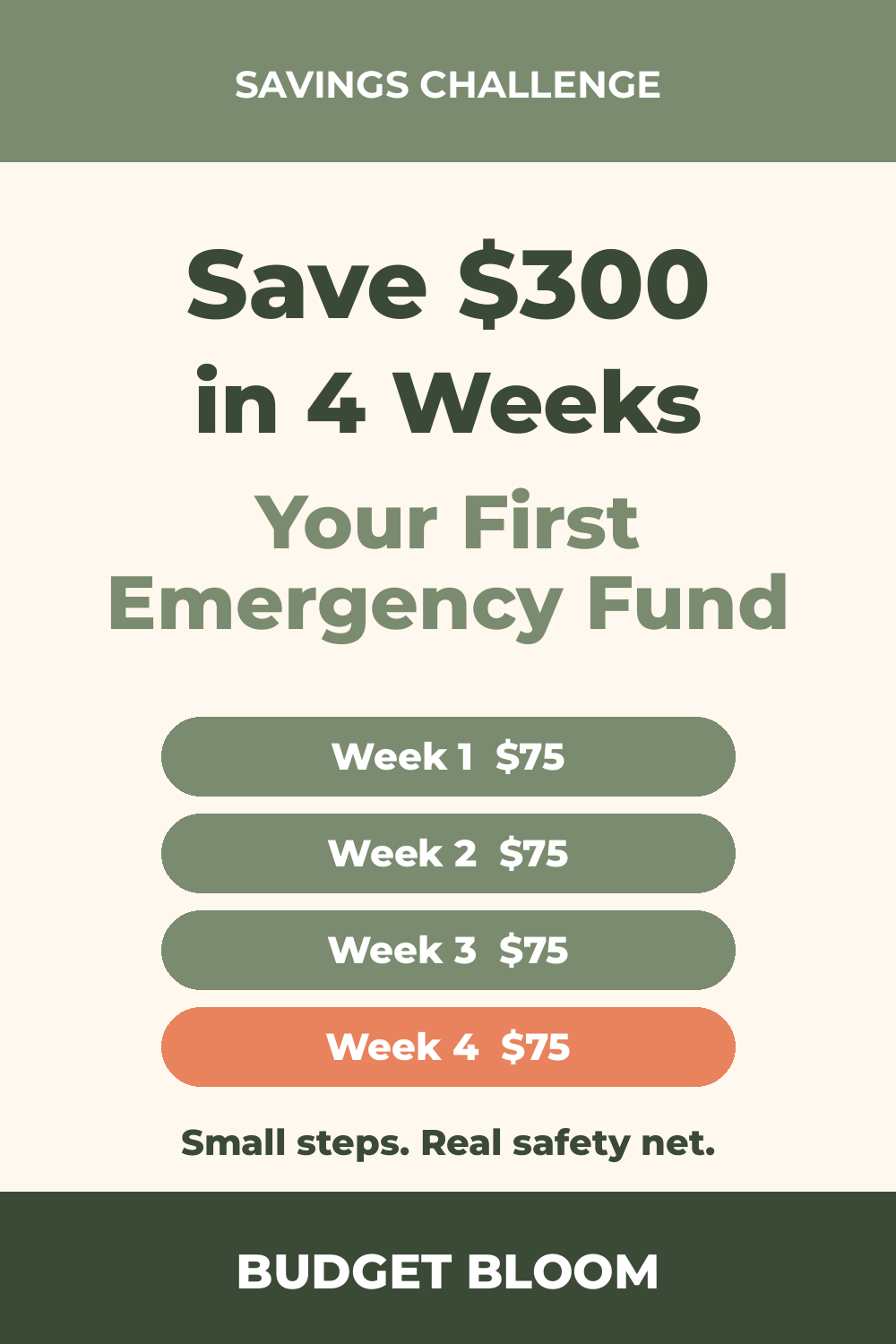
The plan is simple on purpose: save $75 a week for 4 weeks, and you reach exactly $300.
| Week | Amount to save | Running total | One way to find it |
|---|---|---|---|
| Week 1 | $75 | $75 | Pause one subscription and cook two extra dinners at home |
| Week 2 | $75 | $150 | Sell two or three items you no longer use |
| Week 3 | $75 | $225 | Pack lunch every workday this week |
| Week 4 | $75 | $300 | Use the 24-hour rule on every non-essential purchase |
| Total | $300 |
The "one way to find it" column is a starting idea, not a rule. Your $75 can come from anywhere: a lighter grocery week, overtime, cashback, or skipping one delivery order. Mix and match whatever fits your life.
How to Run Each Week
On payday: move the money first
Transfer your $75 to your emergency fund on the day money arrives, not at the end of the week. Saving what is left over rarely works, because leftovers have a way of disappearing. Saving first works because you simply live on what remains, and most people barely notice $75 gone when it never sat in their spending account.
Mid-week: do one small money move
Each week, pick one supporting action: list an item for sale, plan five dinners, cancel a free trial before it charges, or pack tomorrow's lunch tonight. Small actions keep the goal in front of you and often produce the next week's $75 by themselves.
End of week: check the running total
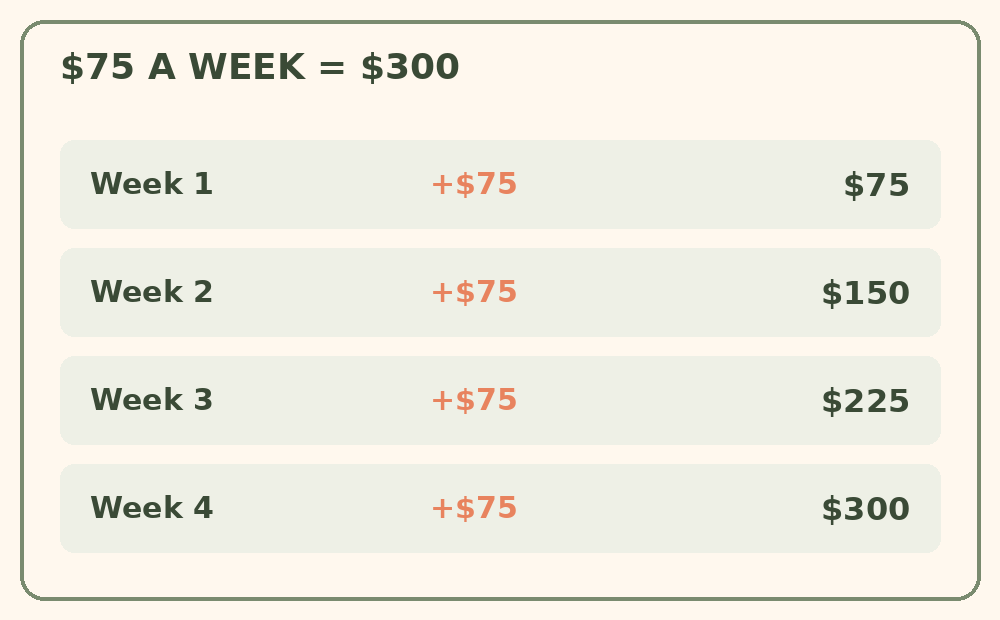
Look at your fund once a week and compare it with the table above: $75, $150, $225, $300. Watching the number climb is the reward that keeps the plan going. If a week falls short — say you saved $50 instead of $75 — add the missing $25 to the next week or add a fifth week. A delayed finish is still a finish.
Where to Keep Your Emergency Fund
Where you keep the money matters almost as much as saving it:
- Keep it separate from your everyday spending account. Money you see every time you check your balance is money you will eventually spend. A separate savings account, ideally at a different bank or in a clearly separate account, adds just enough friction.
- Keep it easy to reach in a true emergency. This fund is for urgent problems, so it should be available within a day or two, not locked away.
- Keep it boring. An emergency fund is insurance, not an investment. Its job is to be there, in full, on your worst week — not to grow fast.
- Name the account. Many banks let you label an account. Calling it "Emergency Fund — Do Not Touch" sounds silly and genuinely works.
What Counts as an Emergency (and What Does Not)
This is the rule that protects your fund after you build it. A true emergency is an expense that is urgent, necessary, and unexpected.
Yes, use the fund: - A car repair you need to get to work - An urgent medical or dental bill - A broken essential appliance, like a fridge - An essential phone or laptop repair for work or school - A sudden loss of income, to cover basics while you regroup
No, save separately instead: - Sale items and shopping deals - Vacations and trips - Gifts and celebrations - Planned bills you knew were coming, like annual renewals - Upgrades — a nicer version of something that still works
If you do use the fund, that is not failure. That is literally its job. Just make rebuilding it your next savings goal, $75 a week at a time.
FAQ
What if I cannot find $75 every week? Shrink the step, not the goal. Save $50 a week for 6 weeks or $40 a week for 8 weeks — you still reach $300, just on a longer calendar. A pace you can keep beats a pace that makes you quit.
Should I save this before or after paying off debt? For most beginners, this starter $300 comes first, because it stops new emergencies from becoming new debt. After it is built, send your extra money to debt, then come back and grow the fund further.
Can I keep the fund in cash at home? A small amount of cash at home can be handy, but a separate bank account is safer against loss, theft, and everyday temptation. Keep the main fund in the account.
Conclusion
You are four weeks and four $75 steps away from your first real safety net: $75, $150, $225, $300. Move the money on payday, keep it separate and boring, and only touch it for expenses that are urgent, necessary, and unexpected. Your next step: once this starter fund is built, put the same weekly habit to work on your balances — read our Snowball Plan for Beginners to Pay Off $5,000 of Debt in 12 Months and let your $75 a week start shrinking debt instead.
New here?
Start with the plan that matches your next money goal, and save the pin so you can find it again.
Follow Budget Bloom on Pinterest