How to Pay Off Credit Card Debt Fast — 5 Steps
In this article
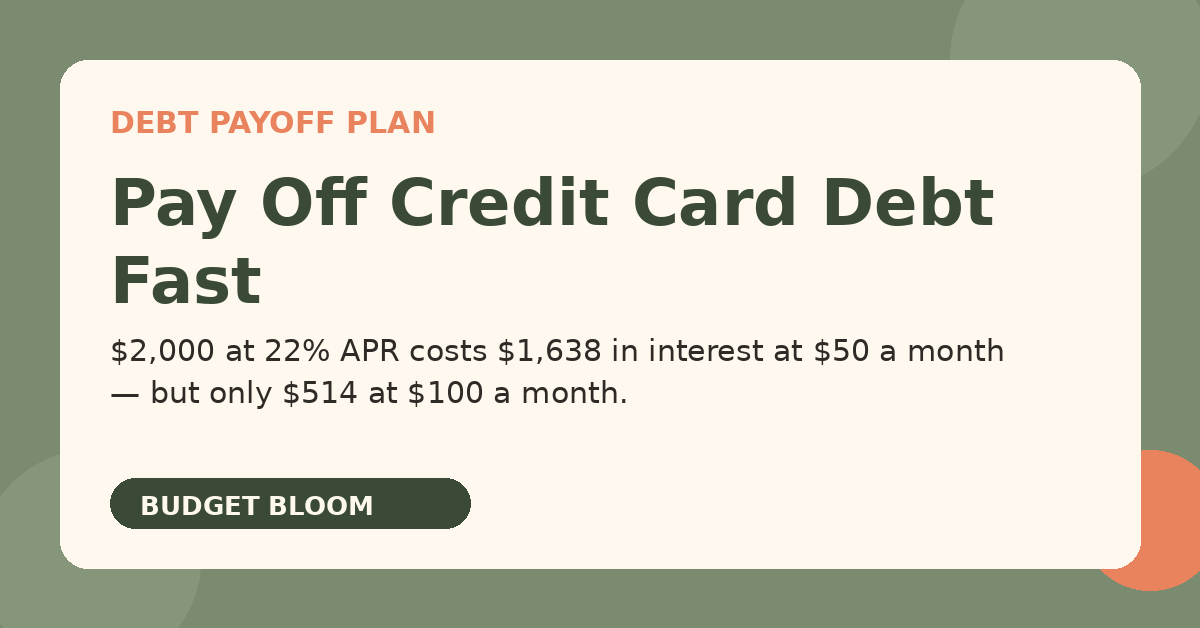
Credit card debt feels endless because most of the payment goes to interest, not to the balance. The way out is not a secret trick — it is paying more than the minimum, every month, in the right order. This guide uses one real example all the way through: $2,000 owed at 22% APR. The numbers are checked, and the plan works at any balance.
The Example, Checked
| Monthly payment | Months to debt-free | Interest paid | Total paid |
|---|---|---|---|
| $50 (minimum-ish) | 73 months | $1,637.82 | $3,637.82 |
| $100 | 26 months | $514.29 | $2,514.29 |
| $150 | 16 months | $314.67 | $2,314.67 |
Assumptions: 22% APR charged monthly (APR ÷ 12), no new charges, payment made every month. Doubling the payment from $50 to $100 saves $1,123.53 in interest and clears the debt almost four years sooner. That is the whole secret: the payment size decides everything.
1. Stop Adding to the Balance
Take the card out of your wallet and delete it from shopping apps and delivery apps. A payoff plan cannot work while the balance grows. Use cash or a debit card for daily spending until the debt is gone. If you need a card for emergencies, keep one frozen — literally, in a bag of ice in the freezer — so using it takes real effort.
2. List Every Card, Smallest Balance First
Write down each card, its balance, and its APR. Attack the smallest balance first — the snowball method. A quick first win keeps you going, which matters more than perfect maths for most beginners. Our snowball vs avalanche comparison shows both methods on the same $5,000 of debt if you want the full picture.
3. Pay More Than the Minimum — Even $25 Extra Helps
The minimum payment is designed to keep you in debt for years — 73 months on our example. Every extra dollar goes straight to the balance, not the bank's profit. Find the extra money with our Save $100 a Month swaps or the 10 moves to save $500 fast, then send it to the card the day you get paid, before you can spend it.
4. Call and Ask for a Lower Rate
One phone call can cut your APR. Call the number on the back of the card, say you have been a loyal customer, and ask for a lower rate or a hardship plan. Mention a cheaper competing offer if you have one. Even a drop from 22% to 15% saves hundreds on a $2,000 balance. If they say no, ask for the retentions team and ask once more. This is the same call as step 6 in our Save $500 Fast plan — it saves money twice.
5. Automate It and Track the Balance Monthly
Set an automatic payment for the day after payday — at least $100 on our example, more if you can. Then check the balance once a month and write it down. Watching the number fall is the motivation that keeps the plan alive. If a month is tight, pay the minimum and get back on track next month — one slow month does not ruin the plan, quitting does.
What to Do After the Card Is Paid Off
- Keep the card open — closing it can hurt your credit score. Just stop using it for daily spending.
- Redirect the payment. The $100 a month you were paying becomes your emergency fund. Our Save $300 in 4 Weeks plan takes three months of it.
- Build the buffer next. A $500 buffer, built with our paycheck-to-paycheck steps, stops the next emergency from going back on the card.
FAQ
Should I pay the smallest balance or the highest interest first? Smallest balance first (snowball) if you need motivation — quick wins keep you going. Highest interest first (avalanche) if you want the lowest total cost. Both work; the one you actually stick to is the right one.
Is it worth paying $150 instead of $100? Yes — on our example it saves another $199.62 in interest and finishes 10 months sooner. Pay the most you can afford every month, even if the number changes month to month.
What if I can only afford the minimum right now? Pay it, every month, on time — and stop new charges. Then find $25 extra with one swap from our Save $100 a Month guide. Even $75 a month beats $50 by years.
Conclusion
Credit card debt is beaten by payment size, not by willpower: stop new charges, attack the smallest balance first, pay more than the minimum, ask for a lower rate, and automate the payment. On $2,000 at 22% APR, $100 a month instead of $50 saves $1,123.53 and four years. Start with the phone call and the first $100 payment this week — the balance only falls when the payments start.
New here?
Start with the plan that matches your next money goal, and save the pin so you can find it again.
Follow Budget Bloom on Pinterest