Pay Off $5,000 of Debt in 12 Months — Snowball Plan for Beginners
In this article
Debt feels heaviest when it feels endless. A balance that just sits there, month after month, can make you feel stuck no matter how hard you work. The good news is that $5,000 is a very finishable number. Spread over 12 months, it works out to about $417 a month — and with the snowball method, you will feel progress in the very first month, not just at the end. This guide shows you exactly how the snowball works, the simple monthly math, and a month-by-month plan you can follow even if you have never made a budget before.
What Is the Debt Snowball Method?
The snowball method is a payoff order, and it is built on motivation:
- List all your debts from the smallest balance to the largest, ignoring interest rates.
- Pay the minimum on every debt so nothing falls behind.
- Throw every extra dollar at the smallest debt until it is gone.
- Roll that entire payment into the next smallest debt. Your payment grows like a snowball rolling downhill.
- Repeat until you are debt-free.
Why start with the smallest? Because quick wins keep you going. Clearing one whole debt in a few weeks or months proves the plan is working, and that confidence is what carries most people to the finish line.
Here is an example $5,000 debt list, arranged snowball-style:
| Debt (example) | Balance | Order |
|---|---|---|
| Medical bill | $400 | 1st — attack first |
| Credit card balance | $1,600 | 2nd |
| Personal loan balance | $3,000 | 3rd — attack last |
| Total | $5,000 |
The Simple Monthly Math
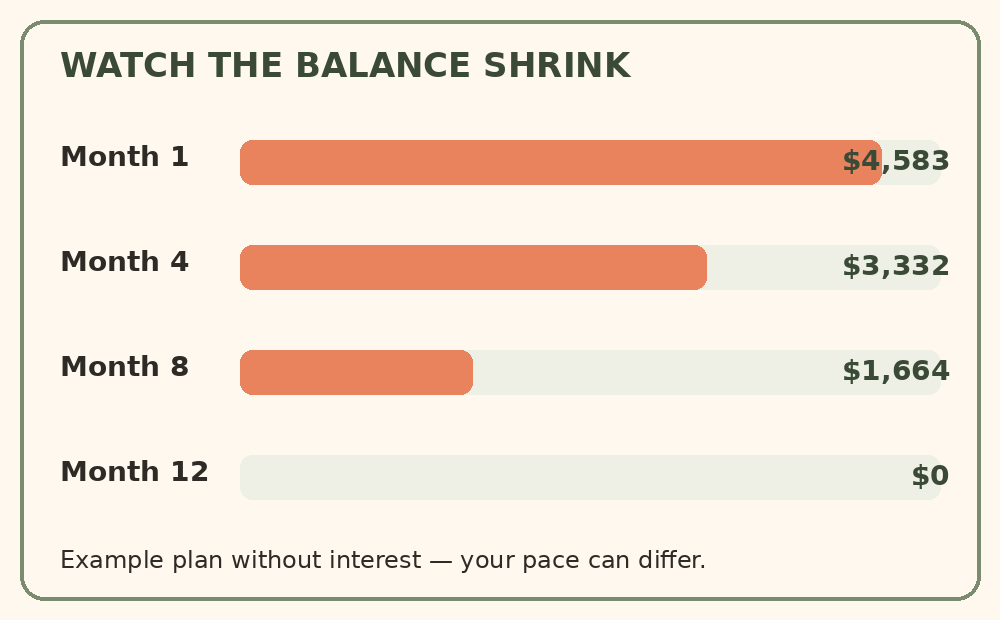
This example keeps the math deliberately simple and does not include interest. Real balances usually grow a little from interest while you pay them down, so treat the numbers below as a clear illustration of the plan, not a promise about any specific account.
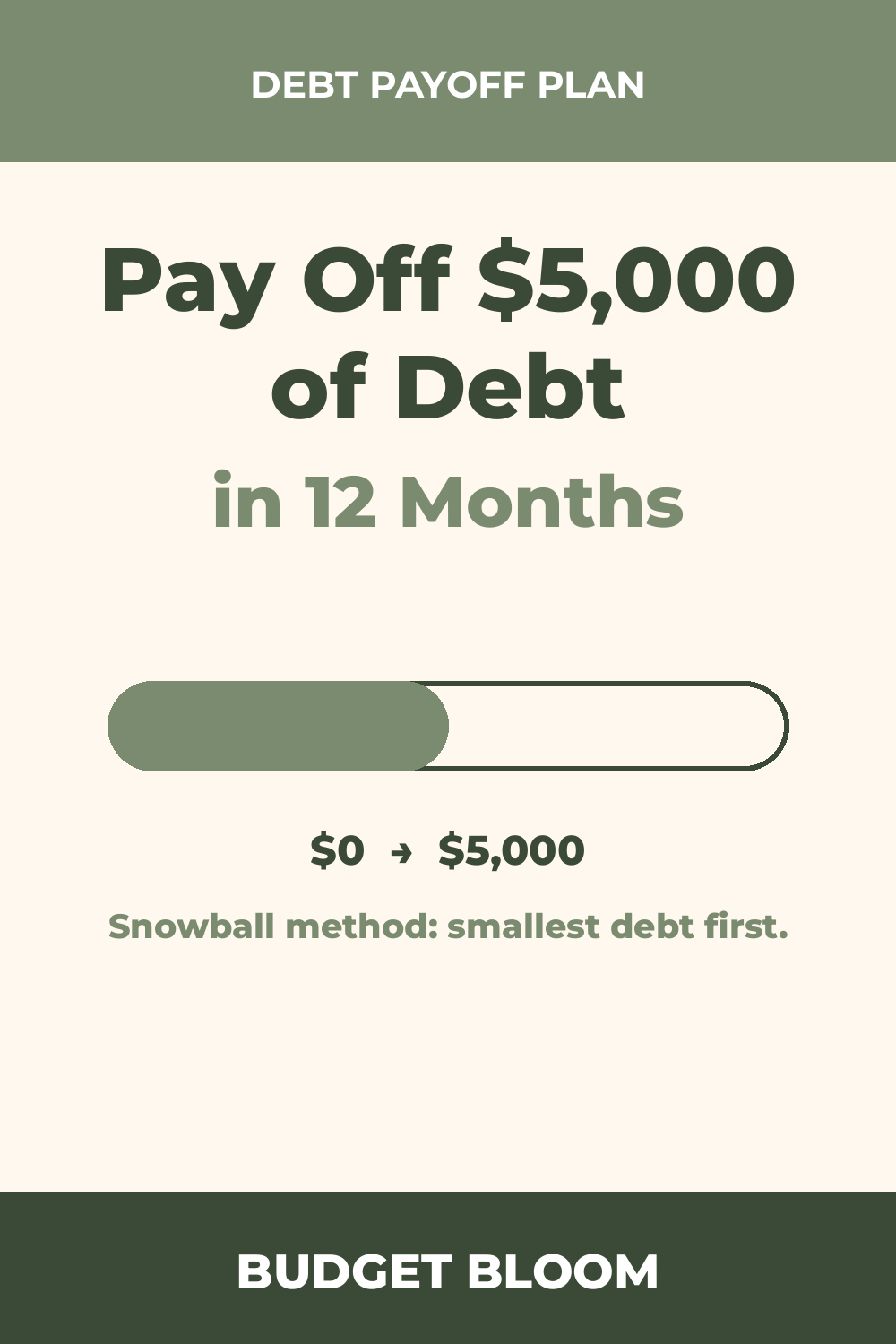
- Total debt: $5,000
- Goal timeline: 12 months
- Monthly payment needed: $5,000 ÷ 12 = about $417 a month
Paying $417 a month for 11 months covers $4,587, and a final smaller payment of $413 in month 12 clears the last of the $5,000. That is the whole calculation. No complicated formulas, no guesswork.
Your Month-by-Month Milestone Table
Post this where you will see it, and cross off each row as you finish it. Watching the balance fall is part of what makes the snowball work.
| Month | Payment | Paid so far | Balance left |
|---|---|---|---|
| 1 | $417 | $417 | $4,583 |
| 2 | $417 | $834 | $4,166 |
| 3 | $417 | $1,251 | $3,749 |
| 4 | $417 | $1,668 | $3,332 |
| 5 | $417 | $2,085 | $2,915 |
| 6 | $417 | $2,502 | $2,498 |
| 7 | $417 | $2,919 | $2,081 |
| 8 | $417 | $3,336 | $1,664 |
| 9 | $417 | $3,753 | $1,247 |
| 10 | $417 | $4,170 | $830 |
| 11 | $417 | $4,587 | $413 |
| 12 | $413 | $5,000 | $0 |
Halfway through, at month 6, you will already have paid off more than half the balance. Most beginners say month 6 is when the plan stops feeling hard and starts feeling automatic.
How Small Extra Payments Speed Things Up
The $417 figure is your baseline, not your ceiling. Any extra money — a sold item, a lighter grocery month, a small bonus — goes straight to the smallest debt. Here is what one steady extra can do in this same no-interest example:
- Add $83 extra a month and your payment becomes $500 a month. At that pace, $5,000 is gone in exactly 10 months instead of 12.
- Even a one-time extra $200 in month 1 drops your balance to $4,383 after the first payment and pulls every milestone in the table closer.
Extra payments do not have to be big to matter. They matter because they shorten the plan, and a shorter plan is one you are far more likely to finish.
Where Does the $417 Come From?
Finding $417 sounds hard until you break it into weekly pieces: about $105 a week. Common places beginners find it:
- Pausing or downgrading subscriptions you barely use
- Cooking two or three more dinners at home each week
- Selling items around the house you no longer need
- Sending any irregular income — overtime, tips, a tax refund — straight to the smallest debt before it drifts away
If $417 truly does not fit right now, stretch the timeline instead of abandoning the plan. $5,000 over 18 months is about $278 a month. A slower plan you finish always beats a fast plan you quit.
FAQ
Should I stop saving completely while I pay off debt? Keep a tiny starter cushion if you can, even $300, so one surprise expense does not push you straight back into debt. Then send every spare dollar to the snowball until the debt is gone, and build your full emergency fund afterward.
What if a month goes badly and I can only pay the minimums? Pay the minimums, protect your accounts, and restart the extra payment next month. One paused month delays the plan; it does not break it. Adjust the milestone table and keep going.
Does the snowball ignore interest rates on purpose? Yes. This method is designed around motivation and momentum, not around math perfection. For beginners with several balances, finishing the smallest debt quickly is often what makes the whole plan stick.
Conclusion
$5,000 of debt is not a life sentence. It is about $417 a month for 12 months, paid smallest balance first, with every cleared debt rolling its payment into the next one. List your debts today, make your first extra payment this week, and let the snowball start rolling. Your next step: make sure that $417 actually fits your month — our guide to How to Budget $1,500 a Month in 15 Minutes (50/30/20 Plan) shows you exactly where a debt payment belongs in a beginner budget.
New here?
Start with the plan that matches your next money goal, and save the pin so you can find it again.
Follow Budget Bloom on Pinterest