How to Budget $1,500 a Month in 15 Minutes (50/30/20 Plan)
In this article
If you have ever opened your banking app at the end of the month and wondered where your paycheck went, you are not alone. The problem is usually not how much you earn. It is that your money has no plan before the month starts. In this guide, you will build a complete monthly budget for $1,500 of income in about 15 minutes, using the 50/30/20 plan. No spreadsheet skills, no complicated apps, and no giving up everything you enjoy. Just three buckets, a few honest numbers, and a system you can repeat every month.
What Is the 50/30/20 Plan?
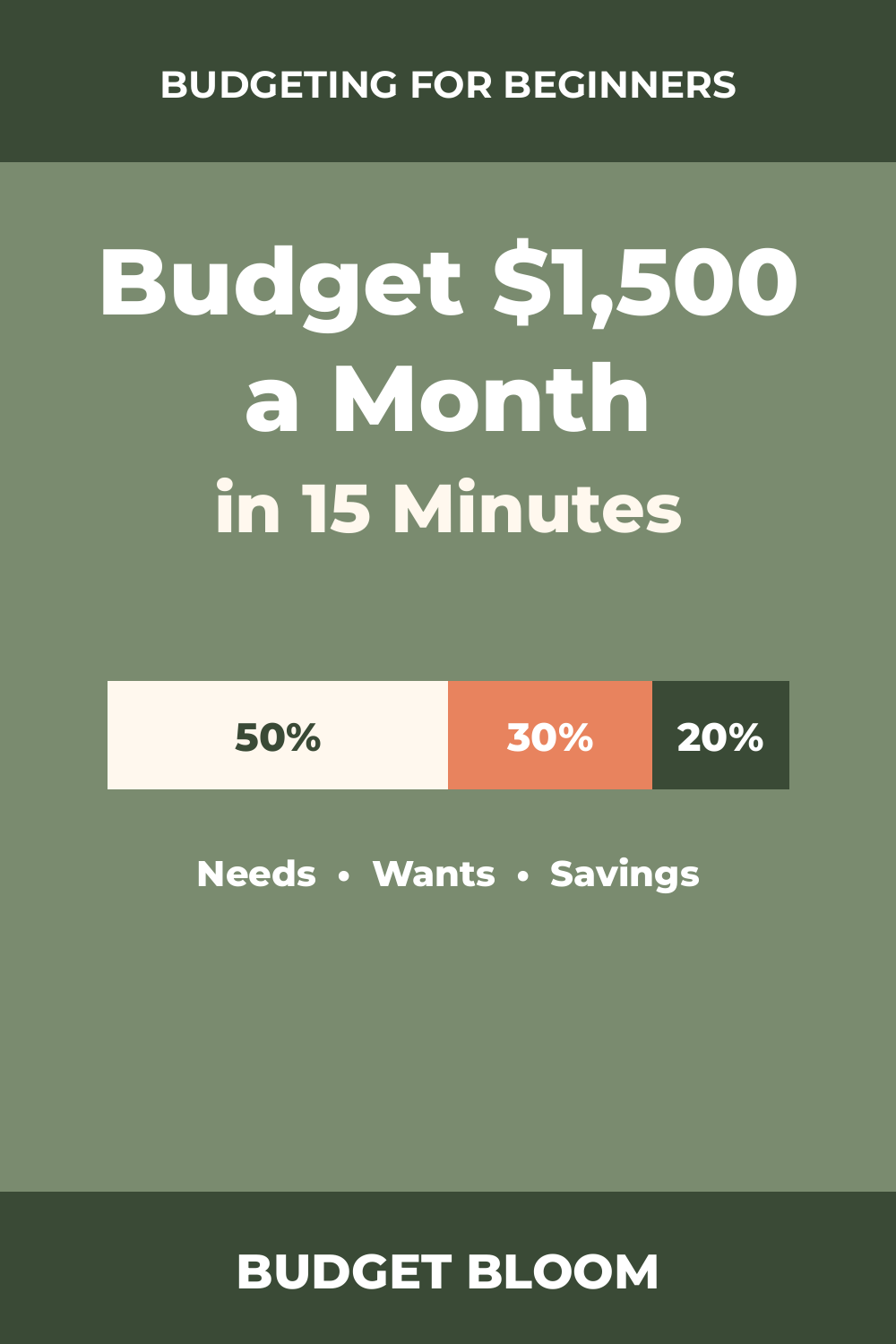
The 50/30/20 plan splits your after-tax income into three buckets:
- 50% for Needs — the bills you must pay to live and work
- 30% for Wants — the fun, flexible spending that makes life enjoyable
- 20% for Savings — money you pay yourself first, for emergencies and future goals
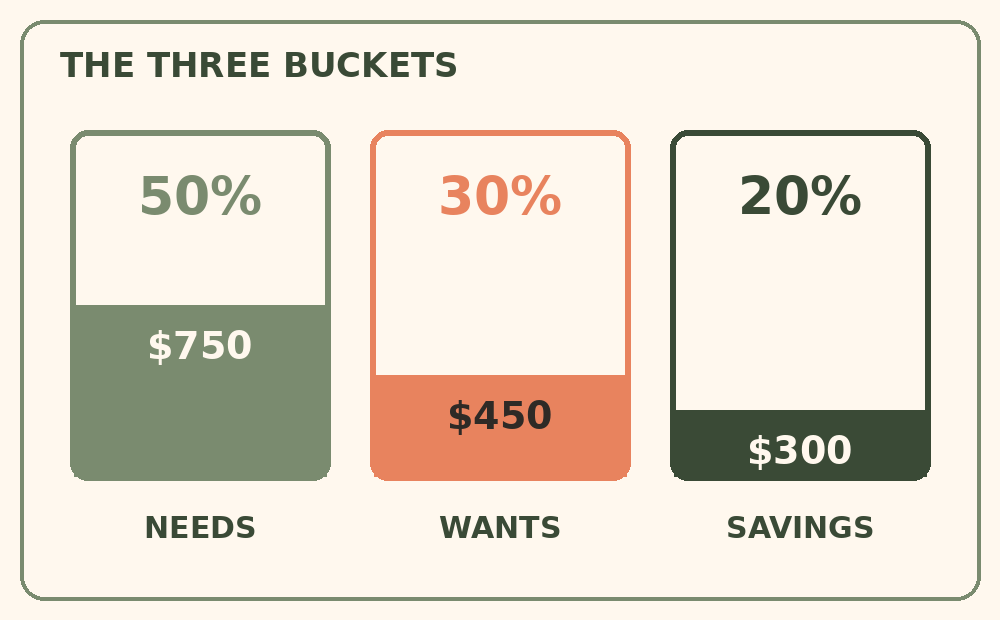
For a $1,500 monthly income, the math looks like this:
| Bucket | Percentage | Amount |
|---|---|---|
| Needs | 50% | $750 |
| Wants | 30% | $450 |
| Savings | 20% | $300 |
| Total | 100% | $1,500 |
That is the whole framework. Everything you spend fits into one of these three buckets, and your only job is to keep each bucket close to its target.
The 15-Minute Setup, Step by Step
Grab your last bank statement or open your banking app, set a timer, and follow these five steps. The minutes add up to exactly 15.
Step 1 (3 minutes): Write down your real income
Write the amount that actually lands in your account each month, after tax. If your pay changes from month to month, use your lowest recent month as the number. Budgeting with a cautious number means a good month feels like a bonus instead of a normal month feeling like a crisis.
Step 2 (4 minutes): List your needs
Write down every must-pay bill: rent or your share of rent, utilities, basic groceries, transportation to work, phone bill, minimum debt payments, and essential medications. Add them up. If the total is over $750, do not panic — the fixes in the section below show how to bring it down over time. If it is under $750, move the extra into savings.
Step 3 (4 minutes): List your wants honestly
Now list the flexible spending: eating out, streaming services, shopping, hobbies, social plans, and personal treats. Be honest here. A budget built on pretend numbers fails by the second week. A budget built on real numbers can actually be adjusted.
Step 4 (2 minutes): Give your savings a job
Decide where the $300 goes before the month begins. A good beginner order is: first build a small emergency fund, then add extra payments toward debt, then save for planned future costs like car repairs or annual bills. Money with a job is much harder to spend by accident.
Step 5 (2 minutes): Set one weekly check-in
Pick one day a week — Sunday evening works well — and spend two minutes comparing what you spent against your three buckets. Catching a problem in week one is easy. Catching it in week four is not.
A Real Example: $1,500 Budgeted With 50/30/20
Here is one realistic way the three buckets can look for a beginner sharing an apartment and keeping spending simple:
| Needs ($750) | Amount |
|---|---|
| Rent (your share) | $450 |
| Utilities | $80 |
| Basic groceries | $150 |
| Transportation | $50 |
| Phone bill | $20 |
| Needs total | $750 |
| Wants ($450) | Amount |
|---|---|
| Eating out | $120 |
| Shopping | $150 |
| Fun and social plans | $100 |
| Personal care extras | $50 |
| Streaming services | $30 |
| Wants total | $450 |
| Savings ($300) | Amount |
|---|---|
| Emergency fund | $200 |
| Sinking funds (car repairs, annual bills) | $100 |
| Savings total | $300 |
Your numbers will look different, and that is fine. The percentages are the guide, not a test you can fail.
What If Your Needs Are Over 50%?
In many cities, rent alone can push needs past $750. If that is you, use the plan as a direction instead of a rule:
- Shrink wants temporarily. Drop wants to 20% ($300) and move the freed $150 to needs while you work on the bigger problem.
- Attack the biggest need first. A cheaper phone plan, a roommate, or a smaller utility bill moves the number more than skipping coffee ever will.
- Grow the top line slowly. Even one extra $100 month of income makes every percentage easier.
The goal for your first month is not a perfect 50/30/20 split. It is simply knowing your three numbers for the first time.
Common Beginner Mistakes to Avoid
- Forgetting irregular bills. Annual subscriptions, car registration, and gifts are monthly costs in disguise. Divide the yearly amount by 12 and save that much each month.
- Budgeting money you do not have yet. Only budget income that has actually arrived.
- Quitting after one bad week. Overspending in one bucket means adjusting another bucket, not abandoning the plan.
FAQ
What if I earn less or more than $1,500? The percentages stay the same at any income. On $1,200, your buckets are $600, $360, and $240. On $2,000, they are $1,000, $600, and $400. Just multiply your income by 0.50, 0.30, and 0.20.
Should debt payments count as needs or savings? Minimum payments count as needs, because you must pay them. Any extra amount you pay above the minimum comes from your savings bucket, because it is money building your future.
How long before this feels easy? Most beginners need about three monthly cycles. The first month is data collection, the second month is adjustment, and by the third month the buckets start to feel automatic.
Conclusion
A budget is not a punishment. It is a 15-minute decision you make once a month so the other 29 days run on autopilot: $750 for needs, $450 for wants, and $300 for savings out of every $1,500. Set your timer, fill your three buckets honestly, and check in once a week. Your next step: use the savings bucket to protect yourself from surprise expenses — read our beginner plan to Save $300 in 4 Weeks — Start Your Emergency Fund and give your first $300 a job that keeps you out of debt.
New here?
Start with the plan that matches your next money goal, and save the pin so you can find it again.
Follow Budget Bloom on Pinterest