How to Pay Off Debt on a Low Income (A Beginner Plan That Works)

In this article
When your income is small, most debt advice feels like it was written for someone else. "Just pay an extra $500 a month" is not a plan when $500 is your grocery money. But you really can pay off debt on a low income — it just runs on a different fuel. Not big payments. Small, steady ones, aimed carefully, that never stop. This guide shows you exactly how to pay off debt on a low income: protect your essentials, keep every account current with minimums, add one small extra payment you can actually afford, and watch the balance fall month after month.
The Rule That Makes This Work
On a low income, the plan has to survive a bad month. A plan that demands $300 extra will collapse the first time the car breaks down, and a collapsed plan usually means missed payments and starting over. So this plan is built on one rule: your extra payment must be small enough to pay even in your worst recent month. Forty dollars paid twelve times beats two hundred dollars paid twice. Consistency is the entire strategy for anyone trying to pay off debt on a low income.
The Beginner Plan to Pay Off Debt on a Low Income, Step by Step
Step 1: List every debt with three numbers
Write down each debt: what it is, the total balance, and the minimum monthly payment. Seeing the real total is uncomfortable for about a day — then it becomes useful, because you cannot aim at a target you refuse to look at. If you are also living paycheck to paycheck, do this step first; the two plans fit together.
Step 2: Keep every minimum payment current
Pay the minimum on every debt, on time, every month. This protects you from late fees — and on a tight budget, one $30 late fee can erase a whole month of extra payments. Automate minimums where you can, timed for the day after payday.
Step 3: Find one small extra amount
Look for $25 to $50 a month. Realistic places low-income households actually find it: one paused subscription, a cheaper phone plan, two home-cooked dinners swapped for takeout, or the savings from a planned grocery week. It does not need to be impressive. It needs to be repeatable.
Step 4: Aim the extra at your smallest balance
Send the whole extra amount to the debt with the smallest balance while the others get minimums only. Small debts disappear fastest, and every debt that hits zero frees up its minimum payment — which then rolls into the next debt. Your payment grows without your budget changing. This is how a $40 extra becomes a $110 extra, then a $190 extra, all from the same tight income.
Step 5: Track the total once a month
Once a month, add up all balances and write down the total. Individual months feel slow; a falling total is proof the plan works and the reason people stick with it in month five.
A Real Example: $2,400 of Debt
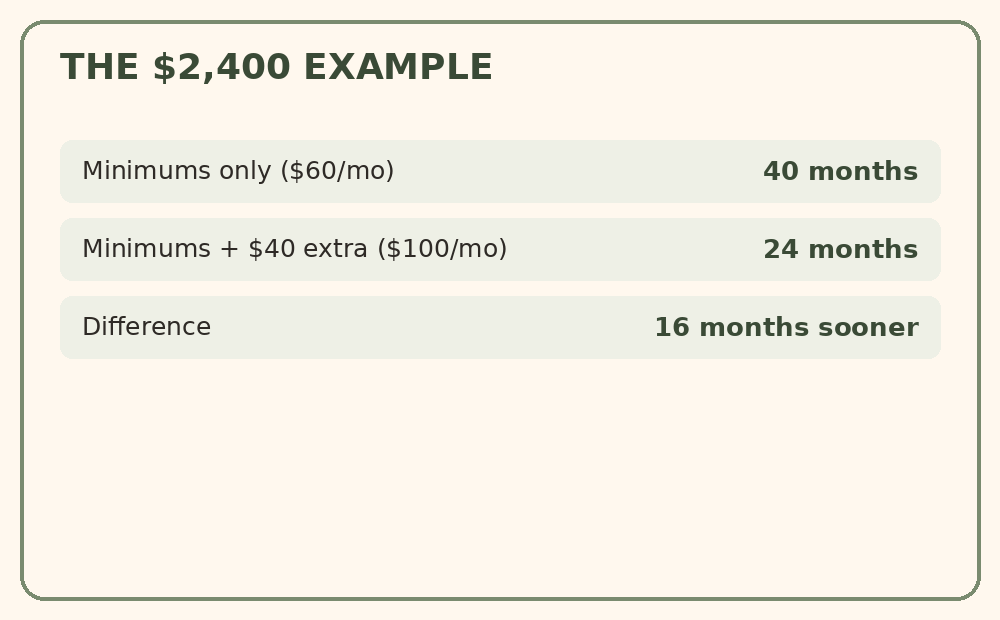
Say you owe $2,400 across a few small debts, and the minimum payments add up to $60 a month. You find $40 extra using Step 3, so you pay $100 a month in total. Here is how the balance falls, shown as a simple example without interest:
| Month | Paid so far | Balance left |
|---|---|---|
| Start | $0 | $2,400 |
| Month 6 | $600 | $1,800 |
| Month 12 | $1,200 | $1,200 |
| Month 18 | $1,800 | $600 |
| Month 24 | $2,400 | $0 |
Now compare: paying only the $60 minimums, at the same simple math, takes 40 months. The extra $40 cuts that to 24 months — debt-free 16 months sooner, from an amount most budgets can find. Real debts charge interest, so real timelines run longer than this example — but the comparison holds: a small extra payment, paid every month without fail, is what shortens the road.
Where to Find the Extra $40
- One grocery week a month, planned. A list, a cap, and store brands can free $30–50 in a single week — see our ways to save $200 a month on groceries for the full method.
- The subscription audit. Many households pay for at least one service they forgot they had.
- The two-dinner swap. Two takeout dinners a month replaced with simple home meals is often $30–40 by itself.
- Sell the storage unit of your home — the closet, the garage shelf, the drawer of old electronics. One-time sales make excellent first extra payments.
FAQ
What if I cannot find any extra money at all? Then your first goal is minimums on time, every month, while you work Step 3 in smaller pieces — even $10 extra is a real start. Also re-check the essentials: phone plans, internet bills, and grocery spending are the three places tight budgets most often find hidden room.
Should I stop saving completely while I pay off debt? Keep a tiny buffer if you can — even $250 in a separate account. Without it, the next surprise expense goes back onto a balance you are trying to shrink. Our beginner emergency fund plan is built for exactly this size of budget. Many beginners split their extra: half to the smallest debt, half to the buffer until it reaches $250, then all of it to debt.
Which debt should get the extra payment if two are the same size? Pick the one whose minimum payment is larger. Clearing it frees more monthly cash, which makes the snowball roll faster into the next debt.
Summary
To pay off debt on a low income, forget heroic payments. Protect your minimums, aim one small extra payment at the smallest balance, roll freed minimums forward, and track a monthly total that keeps falling. A $40 extra turned a 40-month timeline into 24 months in our example — proof that on a tight budget, consistency beats size every single time.
Recommended reading: Pay Off $5,000 of Debt in 12 Months — Snowball Plan for Beginners
New here?
Start with the plan that matches your next money goal, and save the pin so you can find it again.
Follow Budget Bloom on Pinterest