Debt Snowball vs Avalanche — Which Pays Off Debt Faster?
In this article
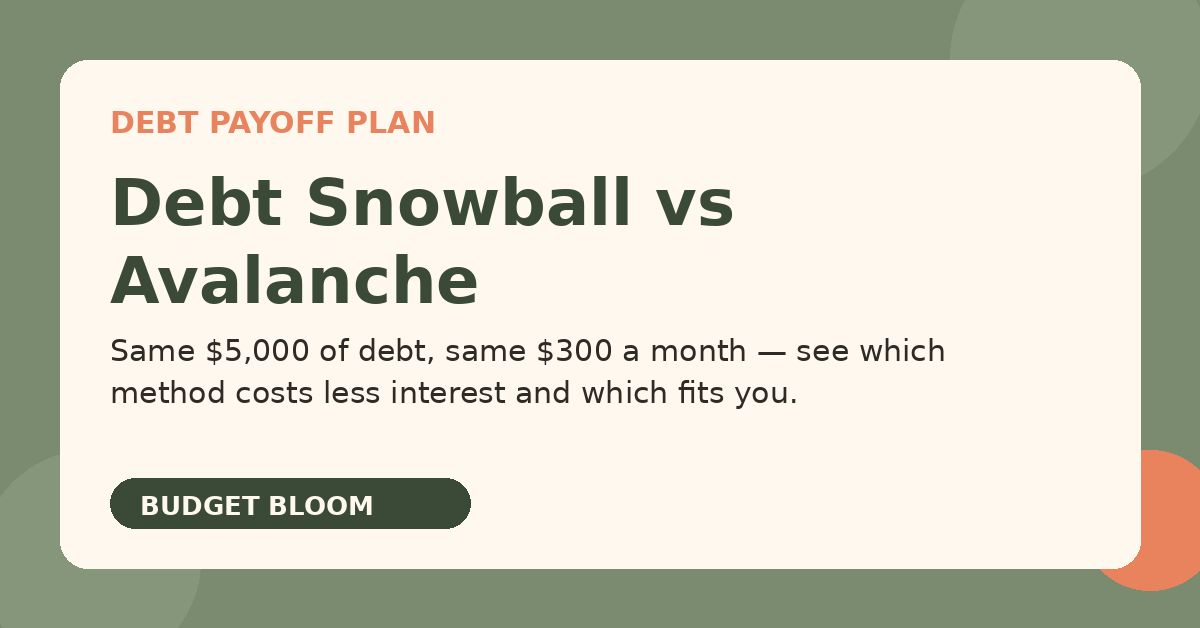
Snowball and avalanche are the two most popular ways to pay off debt. They use the same money and the same minimum payments — they differ only in which debt you attack first. One saves more interest. The other keeps you motivated. This guide compares both with one worked example, so you can pick the one you will actually finish.
The Two Methods in One Paragraph Each
Snowball: list your debts from smallest balance to largest, pay minimums on all of them, and throw every extra dollar at the smallest balance. When it is gone, roll that payment into the next smallest. Quick wins keep you going.
Avalanche: list your debts from highest interest rate to lowest, pay minimums on all of them, and throw every extra dollar at the highest-rate debt. When it is gone, roll that payment into the next highest rate. Maths wins, because expensive debt dies first.
The Worked Example: $5,000 of Debt, $300 a Month
Three debts, $5,000 total. Minimum payments add up to $120 a month, and you add $180 extra, for $300 a month total. No new charges are added while you pay them off, and interest is charged monthly at each APR divided by 12.
| Debt | Balance | APR | Minimum | First-month interest |
|---|---|---|---|---|
| Personal loan | $600 | 10% | $25 | $5.00 |
| Credit card | $1,800 | 24% | $40 | $36.00 |
| Store card | $2,600 | 19% | $55 | $41.17 |
| Total | $5,000 | $120 |
Notice the trap: the smallest debt (the $600 loan) also has the lowest rate, while the highest-rate debt (the 24% card) is in the middle. That is exactly when the two methods disagree — and when the choice matters.
Snowball Order: Smallest Balance First
| Attack order | Debt | Balance |
|---|---|---|
| 1st | Personal loan | $600 |
| 2nd | Credit card | $1,800 |
| 3rd | Store card | $2,600 |
You clear the $600 loan first — a win in about three months — then roll its $25 plus the $180 extra into the card, then everything into the store card.
Avalanche Order: Highest Rate First
| Attack order | Debt | APR |
|---|---|---|
| 1st | Credit card | 24% |
| 2nd | Store card | 19% |
| 3rd | Personal loan | 10% |
You attack the 24% card first, because every dollar there saves the most interest, then the 19% store card, then the 10% loan last.
The Result (Same Money, Same Debts)
| Snowball | Avalanche | |
|---|---|---|
| Months to debt-free | 20 | 20 |
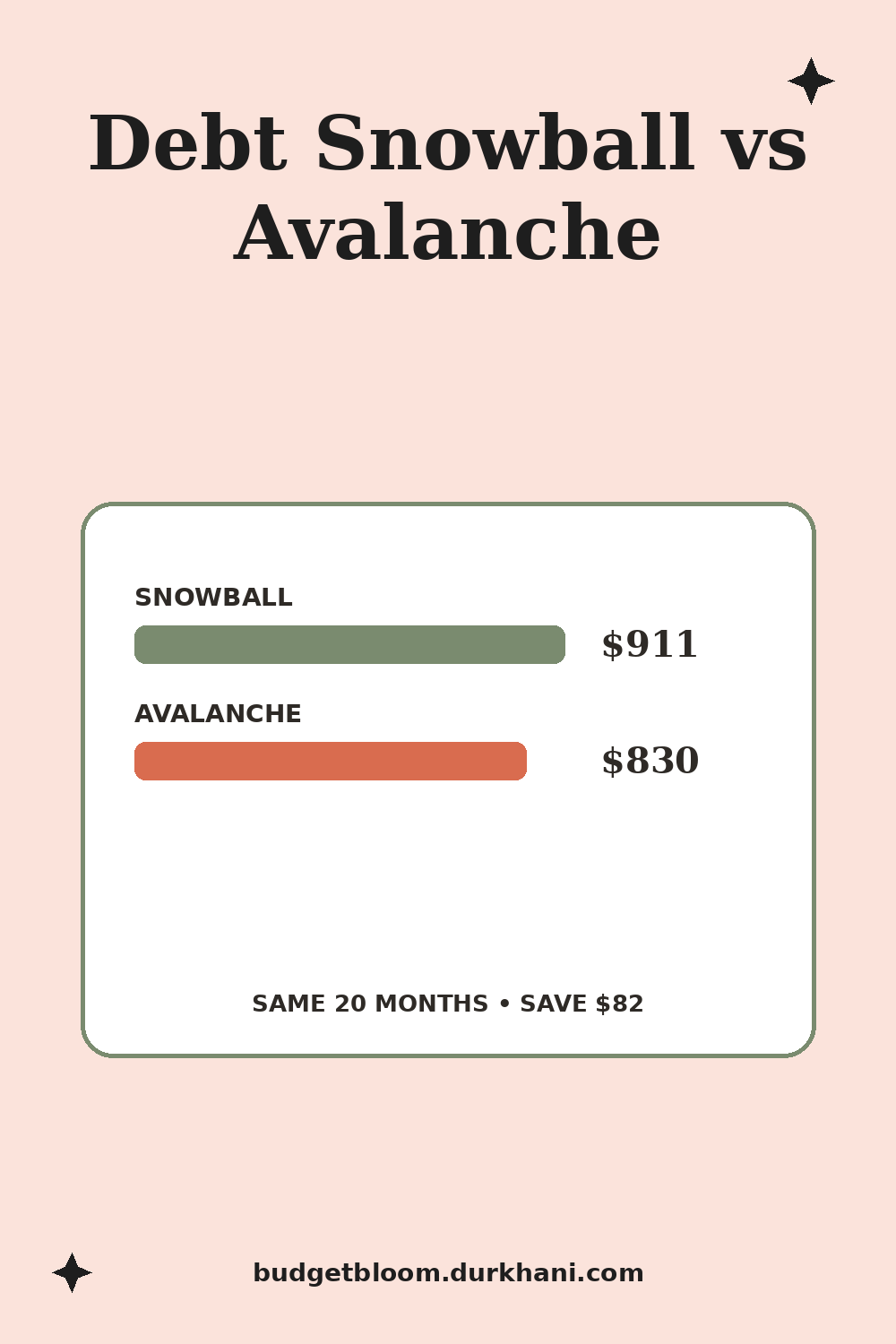
| Total interest paid | $911.36 | $829.80 |
| Total paid overall | $5,911.36 | $5,829.80 |
Both methods clear the debt in 20 months here. Avalanche costs $81.56 less in interest — about 9% less — because it kills the expensive 24% card first. Snowball costs more but delivers the first debt-free win months earlier, when the loan disappears.
Two honest notes: the totals assume you pay $300 every month and add no new charges — miss payments or keep spending, and both plans stretch out. And if your smallest debt is also your highest-rate debt, both methods give the same order, so the debate disappears.
Which One Should You Pick?
Pick snowball if: you have quit payoff plans before, you need early wins to stay motivated, or your smallest debt is small enough to kill in 1–3 months. Motivation is not a soft factor — a plan you finish beats a cheaper plan you abandon.
Pick avalanche if: you are steady with money habits, your highest-rate debt is much more expensive than the rest, or the debts are similar in size so the snowball's early wins are small anyway. You keep about $82 per $5,000 of debt in this example, and more when rates differ widely.
Either is fine if: you pay the same $300 every month either way. The expensive mistake is not picking the "wrong" method — it is paying minimums only, or adding new charges while you pay old ones off.
How to Start This Week
- List every debt: balance, APR, minimum payment.
- Add up the minimums. That is your floor — never pay less.
- Find your extra amount. Even $50 over the minimums changes the timeline; $180 is what this example uses.
- Pick your order by the method above and set the extra payment to auto-pay on payday.
- When one debt hits zero, roll its whole payment into the next one. Do not absorb it back into spending.
If you want a ready-made monthly version of the snowball, our Pay Off $5,000 of Debt in 12 Months guide runs the same idea at a faster pace. And if your month feels too tight to find the extra $180, start with our 10 Easy Ways to Save $500 Fast — the freed-up money becomes your extra payment.
FAQ
Does avalanche always cost less? Almost always, yes — attacking the highest rate first is mathematically cheaper. The exception is when the order is identical under both methods. But "cheaper" only helps if you finish, so a method you quit is the most expensive method of all.
Can I switch methods halfway? Yes. Many people start with snowball for the early wins, then switch to avalanche once only large debts remain. The order is a tool, not a contract.
What if I can only pay the minimums? Pay them on time, every time, and stop adding new charges. Then find even $25 extra — from our save $500 fast list or a meal plan that fits $100 a week — because minimum-only payments stretch a $5,000 balance out for years.
Conclusion
Avalanche wins on maths in our example: same 20 months, $81.56 less interest. Snowball wins on momentum: the first debt disappears months sooner. Pick the one you will still be following in month six — then automate the $300, roll each freed payment forward, and stop adding new charges. Your next step: list your debts tonight and set the first extra payment for payday.
New here?
Start with the plan that matches your next money goal, and save the pin so you can find it again.
Follow Budget Bloom on Pinterest